ByteDefender’s review questions and hypothetical examples are practical application, not claims of a customer incident, independent product test, certification or measured outcome.
A severity label does not finish the decision
A vulnerability queue can contain many high-severity findings and still provide little direction about what should happen first. Teams need to understand whether the affected technology is actually present, how it is used, what is exposed, which safeguards exist and what consequences matter to the organization.
Start by validating the finding and identifying its owner. A scanner observation, an applicable vendor advisory and evidence that a particular deployment is affected are related but different items. Do not let an uncertain inventory match silently become a confirmed exposure.
The aim is not to build an elaborate formula that hides judgment. It is to make the reasons for action visible, consistent enough to review and responsive to new evidence. This article provides a ByteDefender decision record, not a universal ranking or remediation deadline.
Keep the main evidence types distinct
CVSS v4.0 communicates vulnerability severity through Base, Threat, Environmental and Supplemental metric groups. A Base score represents intrinsic severity under defined assumptions; it is not, by itself, a probability that your organization will be compromised or a complete remediation priority. Record the version and vector where available rather than comparing unexplained numbers from different sources. [1]
EPSS estimates the probability that a published CVE will be exploited in the wild within the next 30 days. FIRST explicitly describes EPSS as not being a complete risk score: it does not know whether the vulnerability affects your environment, how much damage exploitation could cause, or which compensating controls exist. Record the observation date because scores are recalculated daily and can change as new signals arrive. [2]
CISA’s Known Exploited Vulnerabilities catalogue is maintained as an authoritative source of vulnerabilities known to have been exploited in the wild. CISA recommends using KEV as an input to vulnerability-management prioritization. It is still an input rather than a complete statement of your organization’s risk, and absence from the catalogue is not evidence that a vulnerability is safe. [3]
Establish applicability before comparing urgency
Identify the affected product, version, configuration and relevant vendor guidance. Check whether the finding concerns an installed component, an unused package, a reachable service or another condition. Document uncertainty instead of resolving it by assumption.
Where an authenticated check or configuration review could improve confidence, assign it to an authorized person. Do not perform intrusive validation outside the agreed scope merely to strengthen a ticket. A safe evidence request may be the appropriate next action.
Retain the original observation and the validation result. If the finding does not apply, record the reason and evidence. A blanket exception for a product family is less useful than a bounded conclusion tied to the actual deployment.
Add exposure and consequence
Ask who can reach the affected component and what prerequisites are required. Consider internet exposure, internal access paths, user interaction and the authority available after successful misuse. A component that is not directly internet-facing can still matter through other relationships.
Then identify the business function, data or service at risk. The same technical condition may have different consequences in a disposable test system and an operational service with sensitive information. Do not infer business impact only from the asset’s name.
NIST’s risk-assessment guidance supports considering threat, vulnerability, likelihood, impact and uncertainty in context. The operational queue below applies that discipline to a bounded treatment decision rather than presenting a CVSS-to-risk conversion. [4]
Examine safeguards without treating them as permanent excuses
A compensating safeguard may change the practical exposure, but its existence needs evidence. “Behind a firewall” does not describe which communication is restricted or whether the relevant path remains possible. Record the safeguard, its owner, the condition it limits and the date it was checked.
Do not assume that a control eliminates every route associated with a vulnerability. State the remaining uncertainty and what would cause the treatment priority to change. A safeguard can fail, be reconfigured or cease to cover a new use of the asset.
Where remediation is deferred, specify the temporary measure, residual concern, accountable decision-maker and review date. The deferral is a risk-treatment decision, not proof that the original vulnerability has disappeared.
Choose a treatment and a verification method
Potential actions may include applying a supported fix, removing an unnecessary component, changing an exposed configuration, isolating a service or replacing unsupported technology. The appropriate choice depends on the actual advisory and operational circumstances; do not improvise a technical remedy from a severity score alone.
Include compatibility, rollback and service-continuity considerations in the change plan. A rushed change without an owner or verification can create another operational problem. Conversely, a difficult change should not remain indefinitely unowned.
Define how the team will establish completion. A deployment ticket may show that a change was attempted; a subsequent approved check provides evidence about the resulting state. Preserve both the action and its validation rather than closing the finding solely because a date has passed.
An illustrative comparison
Consider two fictional findings with the same severity rating. One affects an exposed service used for sensitive operations and appears in an exploitation-evidence source. The other is an uncertain package match in a restricted test environment. Those differences justify asking different immediate questions, not declaring that every first finding always outranks every second finding.
The team validates the product and configuration, confirms the exposure, identifies the service owners and determines the supported treatment. For the uncertain match, the next task may be applicability validation. For the operational service, it may be an urgent change discussion with the accountable owner.
No real CVE, customer incident, exploitation attempt or measured result is implied. The example shows why equal severity labels do not remove the need for contextual evidence.
Keep the queue reviewable
For each decision, record the asset and owner, finding and source, applicability, exposure, exploitation evidence, business consequence, safeguards, treatment, verification and review trigger. Keep links to sensitive technical evidence restricted to the people who need it.
Use a short explanation that another reviewer can understand. “Prioritized because of verified exposure, applicable exploitation evidence and the service consequence” is more informative than a number whose inputs are undocumented.
Review the queue when a new advisory, exploitation report, exposure change or business dependency appears. Date-sensitive inputs should be refreshed rather than copied indefinitely. Historical decisions should remain explainable even when the current priority changes.
Start with the next owned action
Take a small set of important findings and check whether each has an affected asset, a validation state, an owner and a verification plan. Resolve missing context before constructing a more complicated scoring system.
A useful vulnerability-management decision is not simply “this is critical.” It states what is known, why it matters here, who will act and how the result will be checked. That is the bridge between a technical signal and a defensible security improvement.
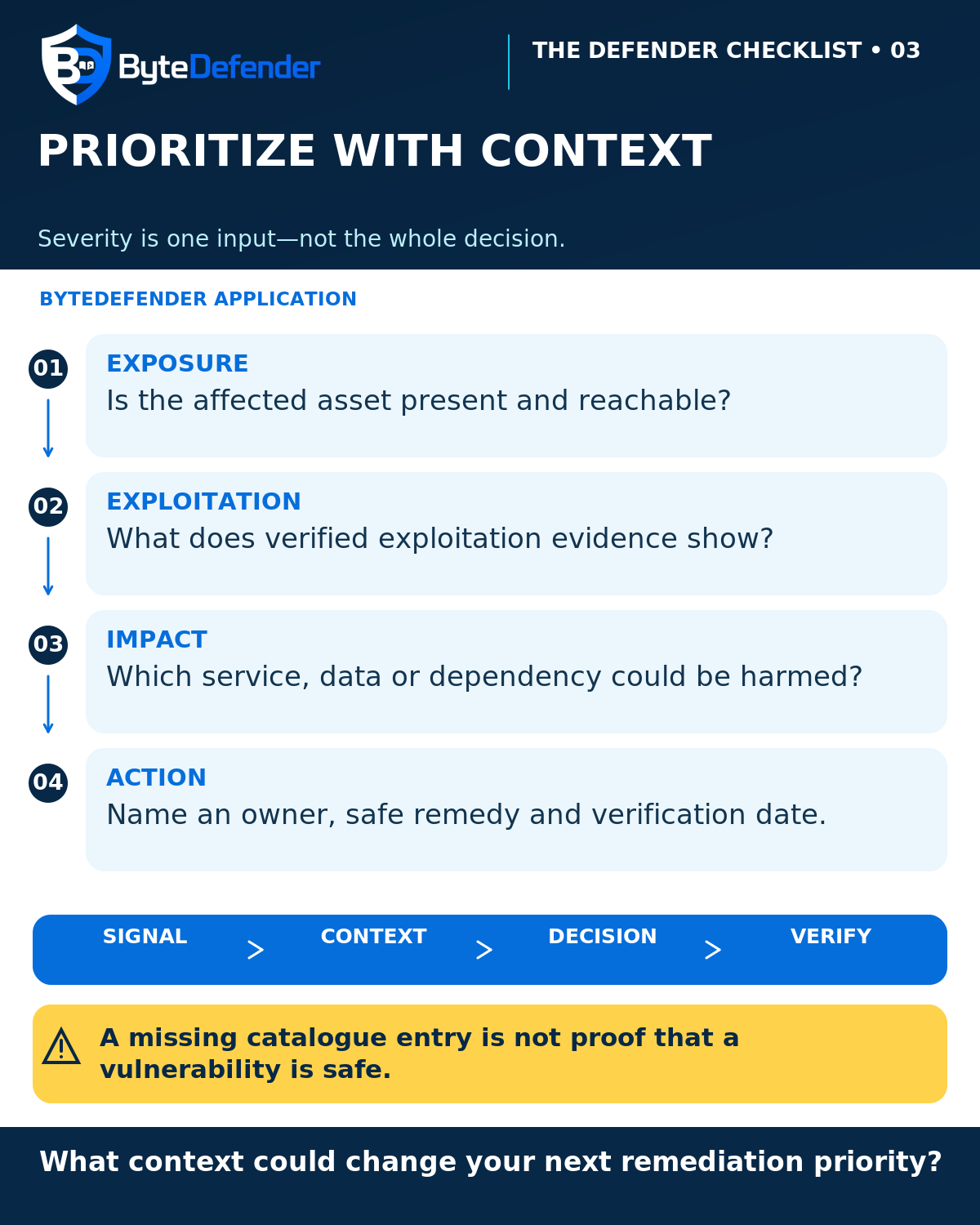
Infographic summary
Severity is one input—not the whole decision.
- Exposure: Is the affected asset present and reachable?
- Exploitation: What does verified exploitation evidence show?
- Impact: Which service, data or dependency could be harmed?
- Action: Name an owner, safe remedy and verification date.
A missing catalogue entry is not proof that a vulnerability is safe.
Sources and further reading
- CVSS v4.0 Specification Document — FIRST. CVSS v4.0. Cited source; checked 2026-10-07. Review scope: Severity characteristics; local response needs additional context.
- EPSS Frequently Asked Questions — FIRST. Current FIRST EPSS FAQ. Cited source; checked 2026-10-07. Review scope: Probability horizon and non-equivalence to local business risk.
- Known Exploited Vulnerabilities Catalog — CISA. Live CISA catalogue. Cited source; checked 2026-10-07. Review scope: Catalog purpose. No current item count, CVE example or deadline is reproduced. Live CISA catalogue reviewed directly.
- Guide for Conducting Risk Assessments — NIST. SP 800-30 Rev. 1; September 2012. Cited source; checked 2026-10-07. Review scope: Risk-assessment scope, uncertainty and decision support; not a quantitative prediction for a specific organization.
- Technical Guide to Information Security Testing and Assessment — NIST. SP 800-115; September 2008. Further reading; checked 2026-10-07. Review scope: Established testing/assessment methodology; dated source retained for method, not current product capabilities.
Connect the decision to an assessment
Explore ByteDefender’s Vulnerability Assessment service for scoped identification, validation and prioritization support.