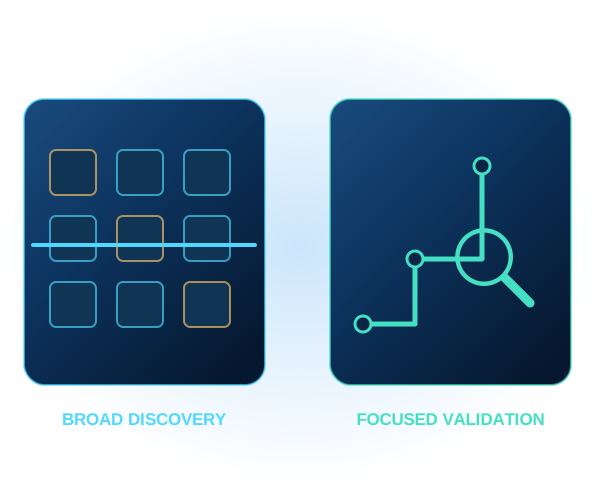
A vulnerability scan and a penetration test produce different evidence. The right choice begins with the decision that evidence must support—not with which service sounds more advanced.
What decision must this work support, and what level of assurance would make that decision better?
Begin with the assurance question
A vulnerability scan is suited to asking: Which known weaknesses or misconfigurations can we identify across this defined scope with repeatable coverage?
A penetration test is suited to asking: Within an authorized scope and agreed safety limits, can selected weaknesses or control failures be validated or combined into a meaningful attack path?
NIST Special Publication 800-115 treats vulnerability scanning and penetration testing as distinct technical assessment techniques, each with benefits and limitations. The OWASP Web Security Testing Guide also recommends a balanced approach because no single technique covers every security issue.
What a vulnerability scan can tell you
A vulnerability scan examines reachable systems, services, applications or host configurations and compares observations with checks for known vulnerabilities, missing patches and common misconfigurations. Depending on the objective, it may be external or internal, authenticated or unauthenticated.
Its main strengths are breadth and repeatability. Scanning can help establish a baseline, review a large defined scope, track recurring exposure and identify items that require validation or remediation.
Coverage still depends on the asset inventory, network visibility, supplied credentials, scanner configuration and currency of its checks. NIST notes that scanners can produce false positives and false negatives and that results need expert interpretation. A scanner finding is evidence to investigate—not proof that every reported issue is exploitable or that unreported issues are absent.
A scan is also not the whole vulnerability assessment. A fuller assessment may combine discovery, automated and manual checks, finding validation, business context, prioritization and remediation guidance. OWASP’s Vulnerability Management Guide cautions against treating a working scanner as the entire vulnerability-management programme.
What a penetration test can tell you
In a penetration test, an authorized tester works within agreed objectives, access conditions and rules of engagement to mimic selected attacker behaviours. The tester may examine whether a weakness can be validated, whether several conditions can be combined, or whether a control can be bypassed to reach an agreed objective.
This is useful when the decision depends on attack-path or control-effectiveness evidence—for example, evaluating authorization behaviour in an application, testing whether network segmentation limits movement, or examining a critical workflow under an agreed threat scenario.
Human reasoning is central. OWASP’s testing guidance includes authorization, business logic and API testing, where understanding roles, workflows and intended behaviour matters. Tools can support the work, but they do not replace the tester’s hypotheses, validation and interpretation.
The depth is still bounded. NIST says penetration testing requires careful planning and management approval because testing can affect systems. Experienced testers can reduce operational risk, but cannot eliminate it. The result describes what was tested, under stated conditions, during a defined period—not continuous resistance to attack.
Vulnerability scan and penetration test compared
| Decision dimension | Vulnerability scan | Penetration test |
|---|---|---|
| Primary question | Which known weaknesses are detectable across the defined scope? | Can selected weaknesses or control failures be validated or combined toward an agreed objective? |
| Typical approach | Repeatable automated checks, strengthened by validation and contextual review. | Authorized, hypothesis-driven testing supported by tools and manual analysis. |
| Relative strength | Breadth, consistency and recurring visibility. | Depth, attack-path evidence and business or control context. |
| Human role | Configure access, validate findings, prioritize and manage remediation. | Define hypotheses, test safely and interpret evidence. |
| Useful output | Validated findings, affected assets, remediation guidance and baseline data. | Evidence-backed findings, tested paths, impact context and remediation guidance. |
| Common limitation | False results plus signature, access and visibility gaps. | Point-in-time, scope- and time-bounded evidence influenced by access and tester perspective. |
| Does not establish | That every finding is exploitable or every weakness was found. | That the whole environment is secure or continuously resistant to attack. |
A five-question decision framework
- What decision will the result support? Are you managing a patch backlog, preparing a launch, validating a control investment or prioritizing remediation? A report without a defined user and decision can become shelfware.
- What is actually in scope? List the assets, environments, identities, APIs, network segments and critical workflows that matter. Record exclusions and dependencies. Broad or deep testing can both mislead when the business-critical path is absent.
- What level of evidence is needed? For broad, repeatable visibility into known exposure, begin with scanning as part of a vulnerability assessment. For controlled evidence about a specific control or attack path, scope a penetration test. If both questions matter, use both.
- What operating constraints must govern the work? Agree on written authorization, test windows, production versus staging, permitted and prohibited techniques, emergency contacts, data handling, logging, stop conditions and third-party boundaries.
- What happens after delivery? Assign owners, priorities and target dates before testing starts. Decide how exceptions will be accepted, how fixes will be verified and when rescanning or a bounded retest is appropriate.
Often, the answer is a sequence
An organization may use recurring vulnerability assessment to maintain broad visibility, then use penetration testing at risk-informed moments to examine high-consequence systems, major changes or specific control questions. Appropriate timing depends on risk, change rate, obligations and remediation capacity; there is no universal cadence for every environment.
Neither activity replaces secure architecture, configuration management, testing throughout development, monitoring, incident response or disciplined remediation. Each is one source of evidence within a wider assurance programme.
Scanning and penetration testing are bounded by scope, time, access, tools, assumptions and the environment observed. They can identify or validate findings within those conditions; they cannot guarantee that every security issue was found or that the system is secure.
A rescan or retest can verify specified changes within its own scope. It is not a certification of the whole environment.
Choose the evidence your decision needs
Explore broad identification and prioritization through Vulnerability Assessment, or controlled validation of selected paths and controls through Penetration Testing.
Primary sources
- NIST SP 800-115, Technical Guide to Information Security Testing and Assessment, final publication, September 2008. See the detailed discussion of vulnerability scanning and penetration testing in the official NIST PDF.
- OWASP Web Security Testing Guide v4.2, the versioned stable guide used for the testing-method and balanced-approach references.
- OWASP WSTG v4.2, Reporting, including point-in-time and no-guarantee reporting limitations.
- OWASP Vulnerability Management Guide, covering the vulnerability-management lifecycle beyond scanning. OWASP notes that an update is in progress; source status should be rechecked when this article is reviewed.
Source status and linked guidance last checked 12 August 2026. This article is educational and does not provide legal, regulatory or compliance advice.