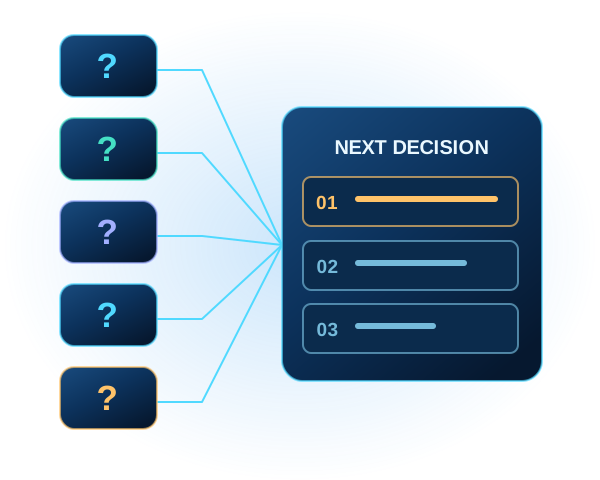
Clear cybersecurity priorities begin with decision questions, not a list of controls. Use these five questions to connect risks and evidence to accountable choices, then record what each answer does and does not establish.
Can a named person use the evidence to make a defined decision, assign an owner and explain the trade-off?
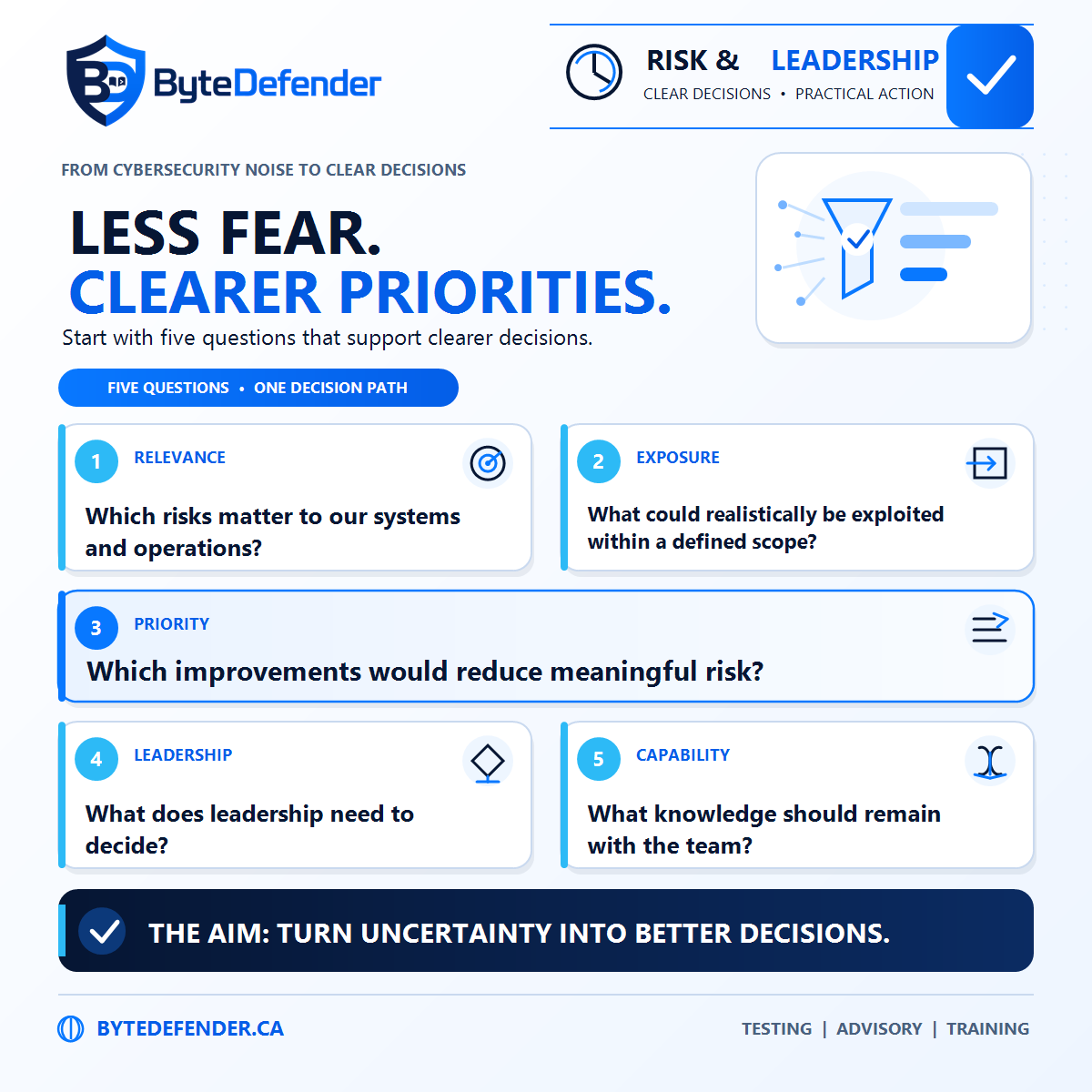
Why these five questions work together
The NIST Cybersecurity Framework (CSF) 2.0 provides high-level outcomes that organizations can use to understand, assess, prioritize and communicate cybersecurity efforts. It is deliberately non-prescriptive: it defines useful outcomes without prescribing one implementation.
The Canadian Centre for Cyber Security baseline controls add practical organizational prompts for Canadian small and medium organizations: define scope, assess the value of systems and information, identify the primary cyber threat, name a responsible leader and commit to progressive improvement. The questions below turn those ideas into a repeatable conversation.
1. Which risks matter to our systems and operations?
Why it matters: a technical weakness becomes decision-relevant when it can affect something the organization values. Begin with critical services, sensitive information, important workflows and the consequences of lost confidentiality, integrity or availability. The evidence may include an asset and service inventory, data flows, business impact analysis, incident history and contractual or legal obligations.
Business or service owners should describe operational impact; IT and security should map systems and dependencies; privacy, legal or compliance participants should contribute where their obligations are relevant. The output is a scoped risk statement linking an asset or process, a plausible event and a consequence.
What this answer does not prove: naming important assets does not show that every dependency, threat or vulnerability has been found.
2. What could realistically be exploited within a defined scope?
Why it matters: priority improves when assumptions are tested against evidence. Define the systems, identities, interfaces, environments, time window, access provided and excluded areas before selecting an assessment method. Evidence can come from configuration review, architecture analysis, vulnerability assessment, threat modelling, logs or an authorized penetration test, depending on the question.
Security and system owners should shape the scope with application, cloud, network or operations specialists. Business owners should confirm that critical workflows are represented. The output is a set of evidence-backed scenarios, with conditions, affected assets, confidence and material exclusions recorded.
What this answer does not prove: a bounded assessment cannot establish that untested systems are secure or that no other attack path exists.
3. Which improvements would reduce meaningful risk?
Why it matters: remediation should address the conditions that create or amplify harm, not simply close the largest number of findings. Compare options by expected risk reduction, dependencies, cost, delivery effort, operational effect and time to value. Evidence may include validated findings, control performance, incident lessons, exposure duration and implementation estimates.
Control owners and delivery teams should test feasibility; business owners should assess disruption and residual impact; security should explain assumptions and dependencies. The output is a prioritized treatment plan with an owner, target outcome, milestone and a method for checking whether the change worked.
What this answer does not prove: a higher ranking does not guarantee a control will work in practice or eliminate the underlying risk.
4. What does leadership need to decide?
Why it matters: some choices require authority beyond the security team. Leadership may need to approve funding, change a business process, accept a time-limited residual risk, resolve competing objectives or stop an activity. Present the decision, options, expected consequences, uncertainty and recommended next step in plain language.
The accountable executive or risk owner makes the decision; finance, operations, legal, privacy and security provide relevant analysis. The output is a documented decision with rationale, conditions, resources, due dates and a review trigger. An unresolved item should also have an escalation path rather than disappearing into a report.
What this answer does not prove: executive approval does not transfer accountability away from system and control owners or make accepted risk permanent.
5. What knowledge should remain with the team?
Why it matters: an assessment has limited value if the reasoning leaves with the assessor. Teams should understand the affected workflow, evidence, remediation choices, validation method and warning signs to monitor. Useful transfer can include working sessions, annotated diagrams, reproducible checks, playbooks and a clear record of assumptions.
The people who operate, develop or support the system should own the retained knowledge, with security available to coach and challenge. The output is a maintainable artefact, an assigned custodian and a scheduled point to revisit it after material change or new evidence.
What this answer does not prove: documentation or training alone does not demonstrate that behaviour changed or that a control remains effective.
Turn the discussion into a decision record
| Decision question | Evidence | Owner and contributors | Output |
|---|---|---|---|
| Which risks matter? | Assets, services, data flows, impacts and obligations | Business owner with IT, security and relevant assurance functions | Scoped risk statement and impact rationale |
| What could be exploited? | Architecture, configurations, findings, logs and test results | System owner with security and technical specialists | Evidence-backed scenarios, confidence and exclusions |
| Which improvements matter? | Risk reduction, feasibility, dependencies, cost and disruption | Control owner with delivery, business and security teams | Prioritized treatment plan and validation method |
| What must leadership decide? | Options, consequences, uncertainty and resource needs | Accountable executive or risk owner | Recorded decision, rationale, conditions and review trigger |
| What knowledge remains? | Reasoning, procedures, diagrams, checks and monitoring cues | Operating or delivery team with security support | Maintained artefact, custodian and revisit date |
These questions support prioritization; they are not a complete risk-management method, compliance checklist or assurance opinion. Results remain bounded by scope, evidence quality, timing, access, assumptions and participant judgement. Threats, systems and business priorities can change after the discussion.
Record uncertainty and exclusions, validate important findings, revisit decisions after material change, and use legal, regulatory or sector-specific advice where required. The Canadian baseline controls also state that their guidance is not comprehensive or all-encompassing.
Connect evidence to an actionable risk decision
ByteDefender Risk Assessment helps organizations define scope, examine plausible risk and prioritize practical treatment options.
Primary sources
- National Institute of Standards and Technology, The NIST Cybersecurity Framework (CSF) 2.0, NIST CSWP 29, published 26 February 2024. See also the official publication record and document.
- Canadian Centre for Cyber Security, Baseline cyber security controls for small and medium organizations, Version 1.2.
Source status and linked guidance last checked 12 August 2026. This article is educational and does not provide legal, regulatory or compliance advice.