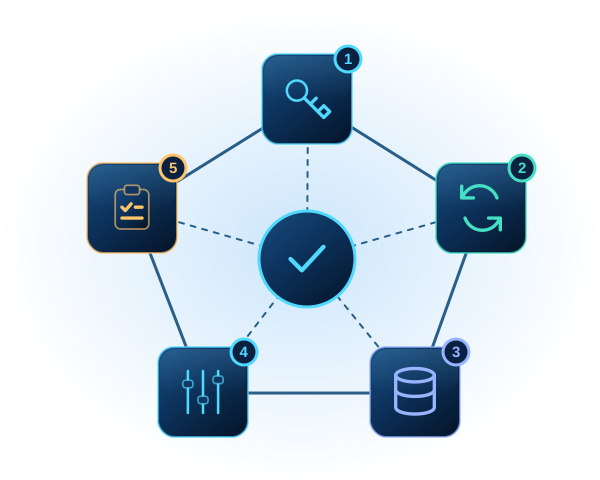
If you could improve only five cybersecurity controls, where would you begin? For many small and medium-sized organizations a practical starting set is strong authentication, timely patching, recoverable backups, secure configuration and incident readiness. The value is not in the list itself. It is in finishing a small number of controls properly and being able to prove each one works.
Why a short list beats a long one
Security frameworks are useful, but they are written to be comprehensive. An organization with a part-time IT lead and no dedicated security staff reads a catalogue of a hundred controls and reasonably concludes that none of it is achievable with the people and time available. The result is a plan that looks thorough and changes nothing.
A short list works for a different reason than most people assume. It is not that these five controls are the only ones that matter. It is that a control which is finished, owned and verified reduces more risk than five controls that are each partially deployed. Attackers do not encounter your intentions. They encounter your configuration.
There is also a plain economic argument. The intrusions that affect smaller organizations are rarely bespoke. They usually rely on something already published: a credential that works without a second factor, a vulnerability with an available patch, a service exposed with its default settings. Closing those routes removes the cheapest attacks first, which is where limited effort buys the most.
If your organization has not yet documented what is in scope, what harm matters and who owns the decisions, begin with How to Scope Canada's Baseline Cyber Security Controls. That context should shape any shortlist.
How to choose your five
The set below is a starting point, not a universal ranking. Your critical assets, likely threats, regulatory obligations and existing safeguards should shape the order. Four questions usually settle it:
- What would hurt most if it were lost, encrypted or exposed? Start where the consequence is highest, not where the work is easiest.
- What is reachable from the internet? Anything exposed is being probed continuously, whether or not anyone is targeting you specifically.
- What has an owner who can genuinely act on it? A control assigned to nobody in particular will still be unfinished in three months.
- What can you verify? If you cannot check it, you cannot claim it — to a client, an insurer or yourself.
1. Strong authentication
Stolen and guessed credentials remain one of the most common ways an intruder gets in, because it requires no vulnerability research at all. A password that works from anywhere in the world is a single point of failure, and phishing, reuse across services and credential-stuffing all attack it directly.
What good looks like: multi-factor authentication required wherever it is supported, prioritising email, remote access and any account with administrative privilege. Where the option exists, phishing-resistant factors such as hardware security keys are materially stronger than codes sent by text message.
Where it usually breaks: multi-factor authentication is enabled for staff but quietly bypassed elsewhere — legacy protocols that do not support it, service accounts, break-glass administrator accounts, or a remote access path that was never brought into the same policy. Recovery methods are a second gap: an account protected by a strong second factor but recoverable through an unprotected mailbox is only as strong as that mailbox.
Verify: can an administrator sign in with only a password? If nobody can answer confidently, that is the finding.
2. Timely patching
Published vulnerabilities are the cheapest route into an organization, because the research has already been done and shared. The gap between disclosure and exploitation continues to shrink, which makes the speed of your process — not its sophistication — the thing that matters.
What good looks like: an inventory first, because you cannot patch what you do not know you operate. Then a named owner, a defined cadence for routine updates, a faster path for critical ones, and an explicit decision about technology that no longer receives security updates at all.
Where it usually breaks: servers and laptops are patched on a schedule while the genuinely exposed things are missed — firewalls, VPN appliances, remote access gateways, network equipment and the internet-facing software that never appeared on anyone's list. Unsupported systems are a related problem: they are frequently known about, tolerated for a business reason, and never revisited.
Verify: which critical updates are overdue right now? Producing that answer should take minutes, not a week of investigation.
3. Recoverable backups
Backups are the control that decides whether a serious incident is a disruption or an existential event. They are also the control most often assumed rather than tested — and modern ransomware deliberately seeks out backup systems before encrypting anything, precisely because doing so removes the victim's alternative.
What good looks like: essential business information backed up; access to backups separated from ordinary administrative credentials; at least one copy that cannot be altered or deleted from the production environment, whether offline or immutable; and restoration tested on a defined schedule.
Where it usually breaks: backup jobs reporting success for years without a single restoration ever being attempted. The failure is usually discovered at the worst possible moment — an incomplete data set, an unavailable encryption key, or a restore that technically works but takes far longer than the business can survive.
Verify: when did a complete restore last succeed, and how long did it take? A backup that has never been restored is a hypothesis, not a control.
4. Secure configuration
Default settings are public knowledge. They are documented by the vendor, indexed by search engines and catalogued by the same tools that scan the internet continuously. A system left in its shipped state is not obscure; it is predictable.
What good looks like: default credentials and settings changed before a system carries real work; unnecessary services, features and accounts disabled; and an approved baseline documented well enough that a second person could rebuild the system the same way.
Where it usually breaks: drift. A carefully hardened environment is gradually loosened by troubleshooting, exceptions and short-term changes that are never reversed. Eighteen months later the running configuration no longer resembles the documented one, and nobody knows when it stopped matching.
Verify: would you detect configuration drift — and how? The honest answer for many organizations is that they would notice only during an incident or an audit.
5. Incident readiness
The first hour of an incident has a disproportionate effect on its cost. Decisions made quickly and badly — rebuilding a compromised system before capturing evidence, notifying the wrong parties, or waiting for an unreachable decision-maker — are expensive and difficult to reverse.
What good looks like: named decision-makers and named alternates; the first actions written down before they are needed; key contacts, including external support, reachable without relying on the systems that may be unavailable; and at least one realistic scenario rehearsed rather than merely documented.
Where it usually breaks: the plan exists as a document on a file share that is encrypted during the incident, or it names a decision-maker who left the organization a year ago. Readiness is also frequently confused with detection: knowing what to do is a different capability from noticing that something has happened.
Verify: does everyone know who can declare an incident? If two people would give different answers, the plan is not yet operational.
Sequencing: what depends on what
These controls are not independent, and the dependencies usually decide the order more sensibly than a severity score does.
- Inventory precedes patching. A patching process without an asset list will faithfully update the systems you already knew about.
- Authentication precedes exposure. If remote access is expanding, strengthen authentication before widening the door, not afterwards.
- Backups precede risk. Establish recoverability before making significant changes, and certainly before any testing that could disturb production.
- Configuration benefits from both. A documented baseline is far easier to maintain once you know what you operate and can restore it.
- Incident readiness is independent. It is the one control that can begin immediately, costs little, and improves outcomes even where the other four are incomplete.
Turning a list into a plan
A list of controls is not a plan. What converts one into the other is small and unglamorous: for each control, record four things.
Do not attempt to perfect everything at once. A control at seventy per cent with a named owner and a review date will usually be finished. A control described as a priority, with no owner and no date, usually will not be.
Where to begin
Choose one control — the one that would reduce the most meaningful risk in your organization, not the one that is easiest to schedule. Give it an owner, an honest current state, one next action and a verification date. Then do the same for the second.
Five controls, finished and verified, put a smaller organization in a materially better position than a longer list that is permanently in progress. The discipline that makes the difference is not technical. It is being willing to check.
Primary sources
- Canadian Centre for Cyber Security, Baseline cyber security controls for small and medium organizations.
- Canadian Centre for Cyber Security, Top measures to enhance cyber security for small and medium organizations, ITSAP.10.035.
- National Institute of Standards and Technology, The NIST Cybersecurity Framework (CSF) 2.0, NIST CSWP 29.
The Canadian Centre for Cyber Security identifies incident response, patching, strong authentication and backups among the measures smaller organizations should address early; secure configuration sits within its broader baseline. The specific five-item selection and ordering in this article are ByteDefender editorial guidance, not an official government ranking. Source status last checked 20 August 2026. This article is educational and does not provide legal, regulatory or compliance advice.