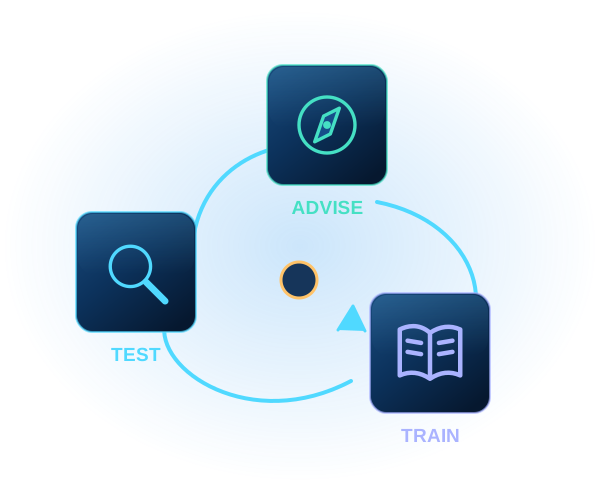
A security activity should not end with the activity itself. Testing can produce evidence, advisory can turn that evidence into direction, and training can help people apply and sustain the resulting improvement.
Why the connection matters
Organizations often purchase cybersecurity activities separately. A test produces findings. An advisory engagement produces recommendations. A training session transfers knowledge. Each can be valuable on its own, but gaps appear when the outputs do not connect.
A technically correct finding may remain unresolved if nobody can translate it into priorities, ownership and an acceptable course of action. A sensible recommendation may not hold if the people responsible for it do not understand the reasoning, process or operational constraints behind it. Training may remain abstract if it is disconnected from the systems and decisions people actually face.
Test: understand what could happen
Testing begins with an agreed objective, scope and set of safety constraints. Depending on the question, it may examine applications, networks, cloud environments, configurations or selected controls. Its purpose is to create useful evidence—not to declare that an environment is secure.
Useful testing distinguishes observed facts from assumptions, explains how findings were validated, and states what remained outside the assessment. This makes the result easier to interpret and reduces the risk of treating a point-in-time assessment as continuous assurance.
Advise: decide what should happen next
Evidence does not prioritize itself. Advisory work connects technical findings with business context: affected services, realistic exposure, existing safeguards, operational dependencies, risk tolerance and available capacity.
The outcome should be clearer choices. Which issue needs immediate action? Which change requires architectural work? Which risk can be accepted temporarily, by whom, and with what review point? Good advice exposes trade-offs rather than hiding them behind a severity score.
Train: build capability that remains
Training supports the people who must implement, operate and maintain the improvement. That may mean helping developers understand a recurring weakness, preparing administrators to use a safer process, giving leaders a clearer decision framework, or rehearsing how a team should respond to a realistic scenario.
Relevant learning is tied to responsibility. It explains not only what action to take, but why it matters, how to recognize exceptions and where to obtain support. A single session is rarely enough by itself; reinforcement through processes, tools and follow-up practice helps knowledge remain usable.
Where should an organization start?
Start with the decision or uncertainty that is limiting progress:
- Start with testing when you need defensible evidence about weaknesses, controls or attack paths in an agreed scope.
- Start with advisory when evidence already exists but priorities, ownership, architecture choices or risk decisions remain unclear.
- Start with training when the required direction is known but people need role-relevant knowledge and practice to apply it consistently.
The work may then move into another part of the cycle. Testing may reveal a decision that needs advisory support. Advisory may expose a capability gap. Training may uncover a process or control that should be tested. The value comes from following the evidence rather than forcing every organization through an identical package.
Three questions to take into your next initiative
- What decision should this work make easier?
- What evidence would be sufficient—and what would remain unknown?
- Who needs the knowledge, authority and process to sustain the resulting action?
Those questions keep the work connected to an organizational outcome without promising that one assessment, recommendation or course will solve cybersecurity on its own.
Need help connecting evidence, decisions and capability?
ByteDefender provides cybersecurity testing, advisory and training shaped around the question your organization needs to answer.