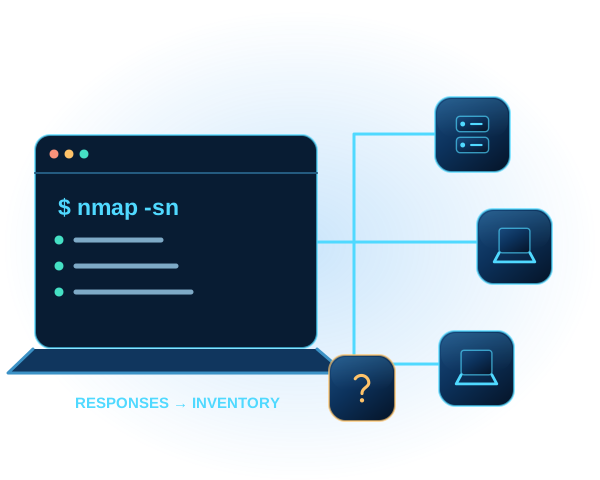
From a security perspective, the question is not only whether a host responds. The stronger question is what that response means for your inventory, risk decisions, and follow-up process.
Start with a better question
Many teams treat network discovery as an endpoint: “we ran Nmap; here are our open ports.” That output is useful, but it is only the first part of the story. A response tells you what is reachable from one approved vantage point under one method at one moment in time.
The operational question is:
“Does every reachable service have a known owner, a clear business purpose, and a justified reason to be exposed in this way?”
That question links technical output to practical security governance. It is also where discovery connects to:
- Asset management and ownership records
- Vulnerability management triage
- Attack-surface decisions
- Security monitoring and alerting context
The infographic style helps with memory, but process discipline creates durable value.
A fit check before every scan campaign
Network scanning without a fit check can produce a lot of signal and little action. For practical value, confirm three prerequisites before the first packet is sent:
Written authorization, explicit scope, and a named owner for follow-up are not optional administrative overhead. They are what keeps discovery technically useful and operationally safe.
- Written authorization: Confirm authority from the system owner for each environment included in scope.
- Closed scope definition: State what is in-scope and out-of-scope, including timing and testing constraints.
- Reconciliation owner: Identify who will validate findings against the asset register and decide required action.
Without these, scan results can be technically correct but operationally weak. You may know “what answered,” yet not know what to do next.
Observed versus proven
Another common confusion is treating observed services as equivalent to verified risk. It is usually not the case.
- An observed response shows visibility, not absolute certainty.
- A detected port may not map exactly to a confirmed service configuration.
- “No response” does not mean “secure” or “not used”; it may reflect segmentation, filtering, or a different path.
- Observed responsiveness from one perspective does not guarantee visibility from another network segment.
In practical terms: treat scan output as evidence to investigate, not as final security judgment.
How this connects to security programs
When discovery is treated as part of a broader program, it can directly strengthen adjacent teams:
- Asset management: unexpected responses reveal where records may need updating.
- Vulnerability management: open services and exposed interfaces are a starting point for evidence-based prioritization.
- Attack-surface management: unauthorized or forgotten exposures become visible as priorities.
- Security operations: monitoring gains better context for unusual inbound and lateral activity.
A practical way to start next week
To avoid turning this into another static report, use this 15-minute weekly step for one service segment:
- Take your latest scan observations for one environment (for example, guest VLAN or public-facing API hosts).
- List each reachable service with confidence level (observed directly, inferred, uncertain).
- Assign owner + business purpose + exposure rationale to each entry.
- Flag any “unexpected + exposed” entries for immediate follow-up review.
- Close at least one follow-up ticket in the next business cycle.
That rhythm tends to be easier for teams than one-off remediation projects. It builds trust between technical teams and operations because it links findings to accountable actions.
A network scan is strongest when it answers “what is potentially reachable right now” and helps assign ownership and urgency. It becomes weaker when it is used as a guarantee of complete visibility or secure-by-default state.
Nmap official documentation and its legal guidance page describe these practical limits and recommend safe operating boundaries for testing from authorized systems.
Primary references
- Nmap Reference Guide
- Host Discovery (Nmap Project)
- Service and Version Detection (Nmap Project)
- Legal and policy considerations for network scanning
We treat scan findings as directional evidence and avoid claims that imply complete visibility, universal detection, or vendor endorsement.
Need support with secure discovery design?
If your team needs help moving from scan outputs to practical ownership, sequence and follow-up, review ByteDefender’s network-security approach.
Review Network Security Services