ByteDefender’s review questions and hypothetical examples are practical application, not claims of a customer incident, independent product test, certification or measured outcome.
Someone notices a suspicious message, sends a file to the wrong place or approves a prompt they did not intend to approve. At that moment, your reporting process competes with uncertainty: what happened, who should be told, and whether speaking up will make the situation worse.
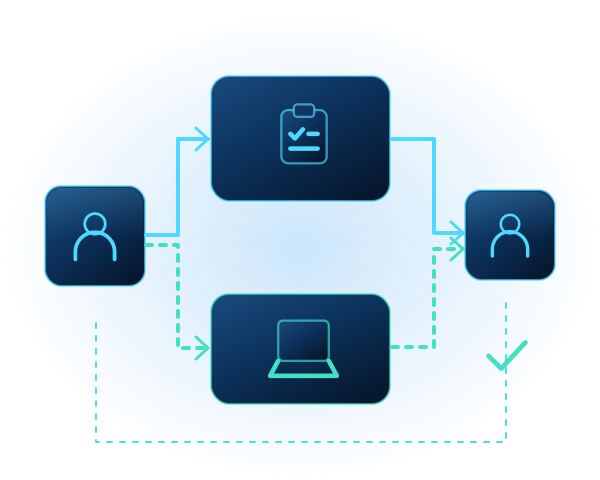
For employees, the first useful action is to report through the organization's approved channel without needing to prove an incident. For managers, the corresponding responsibility is to make that channel workable and respond constructively. These are two halves of the same workflow.
NIST's human-centred cybersecurity work emphasizes understanding people's contexts rather than treating them as a problem to remove. The Canadian Cyber Centre includes training and incident planning in its baseline guidance. ByteDefender applies those ideas to the practical journey from noticing a concern to receiving help. [1] [2]
Start with a real reporting question
Choose one ordinary situation to review. “An employee receives an unexpected sign-in approval request” is more concrete than “improve awareness.” Ask where that person would report it, what information they would be expected to provide and what happens next.
Do not make certainty a prerequisite. A reporting route that asks employees to determine whether something is malicious before contacting support places an investigative burden on the person who needs help. The receiving team can assess the concern and request additional information through a safe process.
The initial report should be small enough to complete under pressure. Depending on the situation, that might include what the person observed, when it occurred and which work service was involved. Do not ask them to paste passwords, authentication codes, private customer records or suspicious file contents into a broad chat channel.
Make the normal route findable
Put the approved reporting method where people encounter the relevant task: an internal help page, an application reporting control or a clearly named contact route. Use the words employees would naturally search for, not only the security team's formal terminology.
Check whether remote workers, contractors and people using mobile devices can use the same instructions. A route that works only from the office network may fail during the very access problem it is intended to handle. Accessibility and language needs should be considered when choosing the interface and supporting instructions.
This is a design review, not a demand for every organization to buy a new platform. A small organization may use a well-managed existing support route. The important question is whether someone owns it and can respond according to the organization's needs.
Provide a fallback when the normal route is unavailable
Ask what happens if work email is inaccessible or suspected to be affected. Provide an approved independent way to reach support or the designated incident contact. Keep the fallback current and reachable without relying entirely on the unavailable account.
Do not solve this by asking staff to send confidential material to personal accounts. The fallback should establish contact and allow the authorized team to direct safe next steps. The Cyber Centre's incident-response planning guidance provides the wider context for named roles and prepared communications; the exact route is an organizational decision. [3]
Assign responsibility for maintaining the instructions. A contact card is not useful indefinitely just because it was accurate when a training session was delivered.
Design the first response
Acknowledge the report and tell the person what to do next. Avoid making unsupported promises about response time; set service expectations that the team can meet and explain how urgent concerns are escalated.
The first response should distinguish safe immediate instructions from investigative requests. A person may need to stop interacting with a suspicious message and wait for guidance. They should not be encouraged to examine attachments, test a questionable link or collect evidence beyond their authority.
Use non-blaming language. “Thank you for reporting; here is the next step” keeps attention on the situation. Accountability for deliberate misconduct is a separate management matter; it should not turn every uncertain report into an accusation.
Close the loop without exposing sensitive findings
When appropriate, tell the reporting person that their concern was reviewed and whether they need to take further action. They do not need confidential investigation details to know that reporting was worthwhile.
For repeated benign reports, improve guidance and system design rather than simply asking people to report less. For repeated genuine concerns, examine whether the underlying control or workflow needs attention. Reporting volume alone does not tell you which situation applies.
Use aggregate patterns carefully. A rise in reports could reflect greater exposure, better recognition, increased trust in the process or a change in the reporting interface. Investigate the context before describing the number as proof that risk has improved or worsened.
Rehearse the process transparently
Run an announced exercise using a clearly fictional example. Ask a small, authorized group to locate the channel, submit harmless sample information and observe the response. Do not secretly collect personal messages or imitate an emergency to create a dramatic result.
Measure obstacles that can be fixed: an inaccessible form, an unclear category, a missing acknowledgement, an outdated telephone number. Give each obstacle an owner and a review date. If the process requires people to remember a long list of details, simplify the first contact and let the receiving team gather the rest safely.
A fictional remote employee might discover that the internal reporting page cannot be opened when the account is locked. The improvement is an approved independent contact route, not another reminder to use the same inaccessible page. That is a workflow finding, not a failure of character.
A manager's review card
| Review point | What good evidence would show |
|---|---|
| Findability | People can locate the approved route during a relevant task |
| Access | Remote, mobile and account-unavailable situations have a supported path |
| Minimum information | A concern can be raised without secrets or unnecessary personal data |
| Response | A named team acknowledges and directs the next safe action |
| Follow-through | Obstacles are owned and the reporting person receives appropriate closure |
These are ByteDefender's proposed review criteria, not a formal certification checklist. Adapt them to staffing, risk, accessibility and service needs.
A practical next step: ask one colleague to show how they would report a concern when their normal email account is unavailable. Use the answer to fix one point of friction. The objective is a process people can use while uncertain—not a policy they can only quote afterward.
Infographic summary
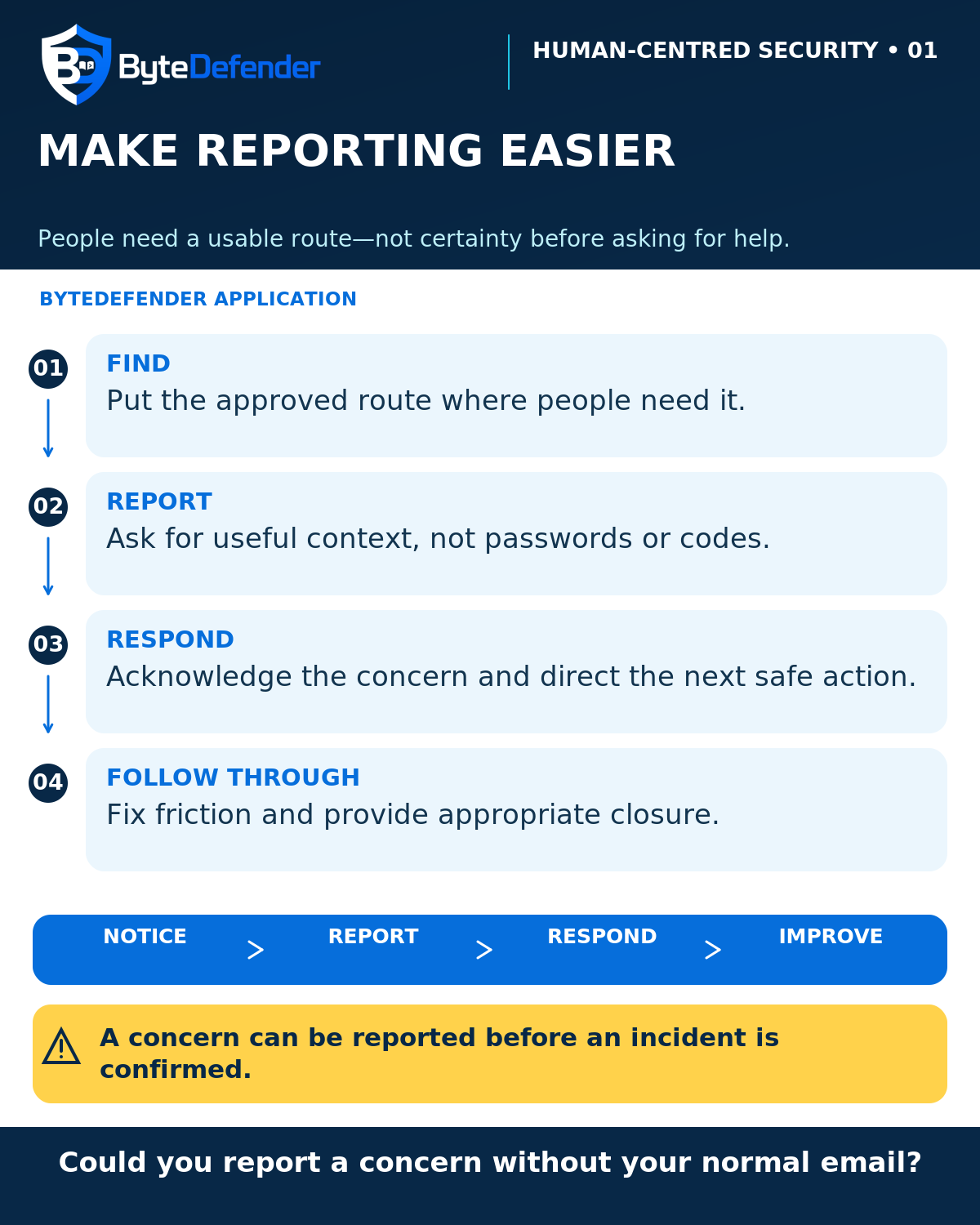
People need a usable route—not certainty before asking for help.
- Find: Put the approved route where people need it.
- Report: Ask for useful context, not passwords or codes.
- Respond: Acknowledge the concern and direct the next safe action.
- Follow through: Fix friction and provide appropriate closure.
A concern can be reported before an incident is confirmed.
Sources and further reading
- Human-Centered Cybersecurity: About — NIST. HTML project overview; revision date not used. Cited source; checked 2026-09-29. Review scope: People, context, usable security; project overview, not an intervention-effect estimate.
- Baseline Cyber Security Controls for Small and Medium Organizations — Canadian Centre for Cyber Security. Version 1.2. Cited source; checked 2026-09-29. Review scope: Organizational context and selected controls: incident response, updates, authentication, awareness and backups. Do not treat the document as a universal compliance standard.
- Developing your incident response plan — Canadian Centre for Cyber Security. ITSAP.40.003; current HTML retrieved. Cited source; checked 2026-09-29. Review scope: Roles, preparation, communication and incident planning.
Connect learning with a usable workflow
Explore ByteDefender’s corporate training to connect security learning with the decisions people need to make.